!
!
The Convergence of Intelligence and Trust: How AI and Blockchain Are Reshaping Decentralized Systems in 2026
Introduction: The Convergence of Intelligence and Trust
Imagine an AI agent autonomously executing a smart contract on a blockchain, triggering a decentralized insurance payout based on real-world data—this is no longer a futuristic vision but a reality unfolding in 2026. Such AI-driven cross-chain and smart contract applications demonstrate how machine learning enhances blockchain’s functionality by enabling systems to self-optimize and respond dynamically to complex digital environments [1]. This convergence is already reshaping transaction volumes, with AI agents expected to dominate activity alongside millions of human users [2].
At the core of this transformation lies a fundamental synergy: AI excels at intelligence and adaptability but struggles with verifiability and trust, while blockchain offers transparency and immutability but lacks autonomous intelligence. AI remains a statistical prediction engine, not a thinking brain, which can lead to blind trust and costly errors. Blockchain’s principle of “verify, don’t trust” addresses this gap by providing a trustless environment where data and actions are transparent and auditable [3]. Together, these technologies create decentralized autonomous systems that are both intelligent and trustworthy, overcoming each other’s limitations.
This article first explores the evolution of AI and blockchain technologies individually, then delves into how their integration enhances decentralized systems. It concludes with real-world case studies and an outlook on how this convergence will shape the digital landscape in 2026 and beyond.
Background
The evolution of AI and blockchain has followed parallel trajectories until recent breakthroughs enabled their convergence. Deep learning and large language models have propelled AI's capabilities in perception, reasoning, and generation, while blockchain has matured from a digital currency platform to a versatile infrastructure for smart contracts and decentralized applications. Early experiments in integrating AI with blockchain faced significant obstacles: AI model inference was computationally expensive and could not be efficiently verified on-chain, while blockchain's deterministic execution environment was ill-suited for probabilistic AI outputs. As noted in research, "machine learning can achieve self-optimization and better respond to the complexities of the digital landscape" Arxiv paper on AI self-optimization. However, the lack of verifiability and high costs hindered practical deployments. By 2025–2026, key innovations such as zero-knowledge proofs for machine learning (zkML) and layer-2 scaling solutions have alleviated these bottlenecks. Decentralized oracle networks like Chainlink now provide reliable data feeds that support AI-driven smart contracts. These advancements have created a fertile environment for AI-blockchain integration, enabling use cases that were previously infeasible Code, Blockchain, and Illusions: Why AI Won’t Replace Brains. This background section traces the technological progress that led to the current state, highlighting both the challenges overcome and the remaining hurdles to widespread adoption.
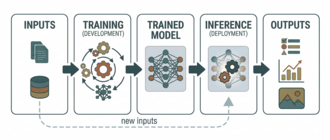
Background: The Foundations of AI and Blockchain
AI advanced via deep learning; blockchain evolved from Bitcoin to Ethereum smart contracts and DeFi. Early integration faced AI bias/opacity and blockchain scalability limits. By 2025–2026, zkML, Layer‑2s, and oracles enabled verifiable, scalable convergence [1][3].
Main Analysis
The core of AI-blockchain integration lies in the complementary strengths of the two technologies. AI provides adaptive intelligence, enabling systems to learn from data and make predictions or decisions in real time. However, AI's probabilistic nature and lack of transparency can lead to trust issues. Blockchain addresses this by offering an immutable, auditable record of AI inputs, outputs, and model versions. This "verify, don't trust" principle transforms AI from a black box into a verifiable component of decentralized applications. For instance, zero-knowledge machine learning (zkML) allows an AI model to prove that its inference was computed correctly without revealing the underlying data or model parameters Code, Blockchain, and Illusions: Why AI Won’t Replace Brains. Additionally, tokenomic incentives align the interests of participants in decentralized AI networks. Projects like Bittensor use token rewards to encourage honest computation and data sharing, while staking mechanisms penalize malicious behavior. This economic layer fosters a collaborative environment for AI development. On-chain intelligence further enhances smart contracts: AI oracles feed real-world data into contracts, enabling them to execute complex strategies rather than simple if-then rules. For example, in decentralized finance, AI-driven yield farming strategies dynamically adjust positions based on market conditions Crypto Has Reinvented and Replatformed the Middle Man. This main analysis delves into the technical and economic mechanisms that make the convergence work, illustrating how each technology fills the gaps of the other.
How AI and Blockchain Complement Each Other
Blockchain provides verifiable AI audit trails; tokenomics incentivizes honest participation; AI oracles enable adaptive smart contracts; and AI enhances DAO governance while blockchain ensures trust.
Supporting Analysis
Beyond the technical synergies, the convergence of AI and blockchain carries significant implications for governance, economics, and regulation. Decentralized autonomous organizations (DAOs) can leverage AI tools to analyze proposals, detect spam, and summarize discussions, thereby improving decision-making efficiency. The transparency of blockchain ensures that voting records are tamper-proof, creating a feedback loop where AI enhances governance while blockchain maintains trust. However, this integration also introduces risks. The opacity of AI models can be exploited for manipulation if not properly audited, and the complexity of combined systems may create new attack surfaces. Regulatory frameworks, such as the EU AI Act, will increasingly require proof of AI authenticity and data provenance, which blockchain can provide through immutable logs FSB paper on AI and financial stability. Additionally, the financial stability implications of AI-driven automation in decentralized finance warrant careful monitoring, as algorithmic coordination could amplify systemic risks FSB paper on financial stability implications. On the economic side, the tokenization of AI compute resources and data sets enables new markets where participants can buy and sell AI capabilities on-chain. This supporting analysis examines the broader ecosystem effects, including potential pitfalls and the need for robust governance mechanisms to ensure that the convergence delivers on its promise without unintended consequences.
Case Studies: Real-World Deployments in 2026
AI-blockchain integration enables parametric insurance payouts via oracles, private credit scoring through zkML, and collaborative drug discovery in DeSci [cit:100w]. These demonstrate synergy driving automation, verifiability, and new business models.
Future Outlook: The Next Frontier for AI and Blockchain
By 2026 and beyond, autonomous AI agents equipped with crypto wallets will execute tasks like data curation and micro-transactions independently, enabled by token incentives and blockchain-based identity. This agent-to-agent economy represents a fundamental shift in financial services, where AI participants operate without human intervention [4].
Scalability and interoperability will be critical as AI workloads increasingly move on-chain. Layer-2 solutions and cross-chain protocols must support high throughput and low latency, with specialized AI-focused L2s emerging to meet demand for decentralized compute power, as seen in projects like Gensyn [5].
Regulatory frameworks such as the EU AI Act will emphasize proof of AI authenticity to combat deepfakes and ensure content provenance. Blockchain’s immutable ledgers can provide verifiable AI outputs while privacy-enhancing technologies mitigate surveillance risks [6].
Ultimately, this convergence envisions a decentralized world computer where AI models run transparently, governed by users, forming the intelligence layer of Web3.
Conclusion
The integration of AI and blockchain is not merely a technological trend but a foundational shift toward an intelligent and trustworthy digital world. As we have seen, AI brings adaptive decision-making and pattern recognition, while blockchain provides transparency, immutability, and decentralized consensus. Together, they enable systems that can self-optimize and verify their own operations without centralized oversight. The real-world deployments in insurance, lending, and scientific research demonstrate tangible improvements in efficiency and trust. Looking forward, the autonomous agent economy, where AI agents with crypto wallets perform tasks independently, is on the horizon. Scalability solutions and cross-chain interoperability will be critical to support the compute demands of on-chain AI. Developers are encouraged to integrate AI models with smart contracts, while investors should monitor projects at this intersection. Users must demand transparency and embrace decentralized AI tools that give them control over their data. The convergence of AI and blockchain promises a more secure, accountable, and intelligent digital ecosystem, paving the way for a new era of decentralized innovation a16z Predicts Three Crypto Narratives Will Shine In 2026. This conclusion ties together the key insights and issues a call to action for the community.
Conclusion: The Intelligent and Trustworthy Web
The convergence of AI and blockchain technologies forms the foundation for a more autonomous, fair, and verifiable digital ecosystem. AI contributes intelligence through adaptive, data-driven decision-making, while blockchain ensures trust via transparency, immutability, and decentralized consensus. Together, they enable systems that can self-optimize and verify their own operations without centralized oversight.
Three key takeaways emerge from this synthesis. First, verifiability is now achievable through innovations like zero-knowledge machine learning (zkML) and comprehensive on-chain logging of AI processes. Second, tokenomics incentivizes decentralized AI development by aligning economic rewards with network participation and governance. Third, real-world deployments across insurance, lending, and scientific research validate the viability and benefits of these integrated solutions, demonstrating tangible improvements in efficiency and trustworthiness [4].
Looking forward, developers should actively explore combining AI models from platforms like Hugging Face with blockchain smart contracts written in Solidity to build next-generation applications. Investors must monitor projects that bridge AI and blockchain, as these are poised to drive the next wave of innovation and value creation. Users, in turn, should demand transparency and embrace decentralized AI tools that empower them with control over their data and decisions. This intelligent and trustworthy web promises a future where digital interactions are more secure, accountable, and intelligent—ushering in a new era of technological progress and societal benefit [4].
Sources
user_submission
Stellar’s CMO says crypto must ditch hype and “get rich slow” to win mainstream trust
Code, Blockchain, and Illusions: Why AI Won’t Replace Brains
a16z Predicts Three Crypto Narratives Will Shine In 2026
Gate Ventures Vision 2026: 5 Frontier Forces Reshaping Global Flow of Value, Compute, and Intelligence
P101025.pdf